
A scale chart maps a playable part of the neck.
It shows where the notes of a scale sit in one position. Unlike a chord chart, the dots are normally played one at a time. The diagram shows available notes, not automatically the order in which every note must be played.
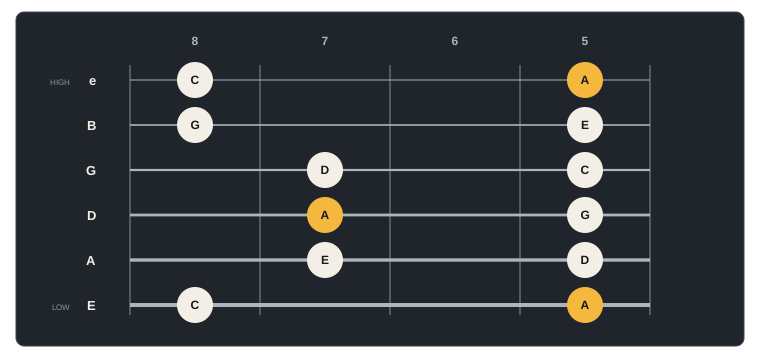
Read fret numbers from right to left.
In our left-handed charts, higher fret numbers are toward the left and the nut is toward the right. The thin high string is at the top, with the thick low string at the bottom.
- 1Fret numbers identify the exact position on the neck.
- 2Off-white dots are notes that belong to the scale.
- 3Gold dots mark A, the tonic of A minor pentatonic.
- 4Dots sit between the fret wires, where the finger is placed.
The chart shows position, pitch and orientation.
High e at the top, low E at the bottom
The thick low string sits at the bottom. String lines become thinner as they move upward toward high e.
Numbers locate the shape
A position away from the nut needs fret numbers. Do not assume the first column is fret 1.
Dots are playable notes
Each dot marks a note from the selected scale. The empty spaces are not part of that pattern.
Gold is home
The tonic gives the scale its name and provides the strongest point of resolution.
For scales, tonic is the precise term.
Guitarists often call the highlighted note the root, and most players will understand what that means. Strictly speaking, a chord has a root and a scale has a tonic.
On our scale charts, gold identifies the tonic. In an A scale, every gold A is a place where the phrase can feel settled.
A tonic C scale tone E scale tone
A scale chart is not a numbered route.
Start on the lowest tonic for a basic ascending run.
In the A minor pentatonic position above, the lowest A is fret 5 on the low E string. Play upward in pitch across the strings and finish on a higher A.
You do not have to begin every musical phrase on A. Starting and ending on the tonic is simply the clearest way to learn the sound of the scale before you improvise with it.
Tab can show one exact path.
The chart shows all notes in the position. Tablature below it can demonstrate a particular ascending or descending exercise.
Tab is read the same way by left-handed and right-handed guitarists. The top line is high e, the bottom line is low E, and the numbers are fret numbers.
e |-------------------------5---|
B |---------------------5-8-----|
G |-----------------5-7---------|
D |-------------5-7-------------|
A |---------5-7-----------------|
E |-----5-8---------------------|
        A C D E G A C D E G A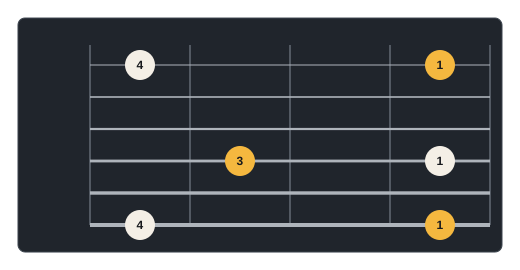
Numbers inside dots usually mean fingers.
1 is index, 2 is middle, 3 is ring and 4 is little finger. They are not the order in which the notes must be played.
Fingerings are suggestions for efficient movement. A different fingering may be better when you change direction, shift position or connect the scale to a phrase.
Both formats describe the same fretboard.
A portrait scale chart is essentially a horizontal neck rotated through a quarter turn. The notes and intervals do not change.
We use horizontal charts because they show movement along the neck more naturally and make it easier to compare several positions at equal width.
Always check the string labels, fret numbers and nut before playing. Those three cues tell you how any unfamiliar chart is oriented.
Four checks prevent most scale-chart mistakes.
- Confirm it is a left-handed chart. On this site, higher fret numbers sit toward the left.
- Find the tonic before trying to memorise the rest of the pattern.
- Do not mistake finger numbers for note order.
- Use the chart as a map, then use tab or a short exercise when you need a specific route through it.
Choose a scale and read it in context.
Select a tonic and scale type, then compare useful left-handed positions.